


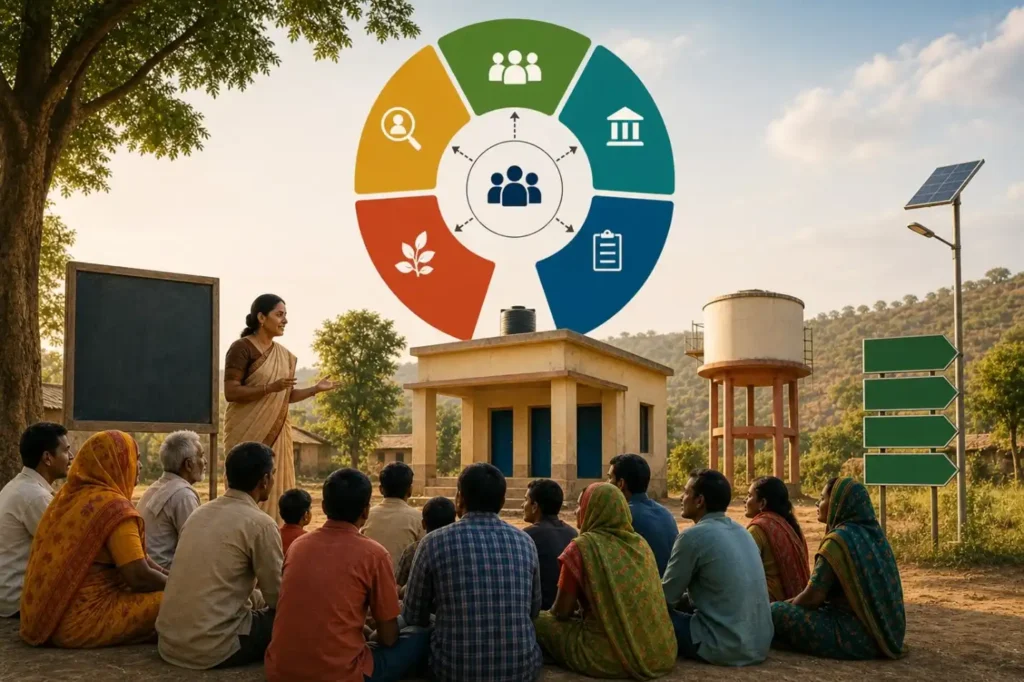
When India extended democratic decentralisation to tribal regions through the Panchayats Extension to Scheduled Areas Act, 1996, it acknowledged a simple but powerful reality that governance in tribal societies did not begin with the Constitution. For generations, tribal communities have governed themselves through institutions rooted in consensus, customary norms, and collective decision making. Observations from Jhabua district in Madhya Pradesh show that village governance continues to be shaped not only by elected Sarpanches but also by traditional village heads such as Patels and Tadvis. Welfare delivery decisions, dispute resolution processes, and local development initiatives often acquire legitimacy only when endorsed by these customary authorities. The future of decentralisation in tribal India will therefore depend on whether democratic institutions can coexist with these deeply embedded governance traditions. In Jharkhand, community decision making continues to be mediated through institutions such as Mundas, Manjhis, and Parha. In Chhattisgarh and Odisha, village governance frequently involves Gaon Mukhiyas, clan elders, and traditional councils. Government reviews of PESA implementation have noted that such leadership systems historically regulated land ownership, resolved social conflicts, and managed forest resources long before formal Panchayat systems were introduced. The Indian Constitution recognised the importance of preserving these governance traditions. Article 244 and the Fifth Schedule provide special protections for tribal regions, acknowledging that uniform governance models cannot adequately address the cultural and institutional diversity of tribal societies. Article 243M excludes Scheduled Areas from the automatic application of Panchayati Raj provisions, enabling Parliament to design decentralisation models suited to tribal governance systems. The PESA framework built on these protections by granting Gram Sabhas authority over forest produce, land protection, local markets, and welfare monitoring. India’s Scheduled Areas span 10 states and 108 districts, but the reach of the Panchayats (Extension to Scheduled Areas) Act, 1996 remains uneven, only 45 districts are fully covered, while 63 are only partially brought under its ambit. Across 77,564 villages and 22,040 panchayats, this patchy implementation reveals a clear gap between constitutional promise and on-ground governance, as noted by the Ministry of Tribal Affairs and the Ministry of Panchayati Raj. Such partial implementation limits the ability of Gram Sabhas and indigenous leadership structures to exercise meaningful authority and weakens participatory governance. As seen across India’s Scheduled Areas, for e.g. Patel and Tadvi (Madhya Pradesh), Munda and Manjhi (Jharkhand), Naik and Gaon Pradhan (Odisha), Gaon Mukhiya (Chhattisgarh), Gameti (Rajasthan, Gujarat), Naik (Maharashtra) traditional leadership varies widely. As India expands welfare, digital governance expand into tribal regions, the question of institutional legitimacy is becoming increasingly urgent. Decentralisation risks losing its democratic character if community assemblies function only as administrative ratification forums rather than as platforms of collective decision making. Administrative interpretations of Panchayat laws have increasingly concentrated decision making within elected executive structures. In several states, Sarpanches preside over Gram Sabha meetings, gradually transforming community deliberation platforms into procedural exercises linked to scheme approvals and financial compliance. When decision making authority shifts away from community assemblies, indigenous leaders who historically facilitated village consensus lose institutional relevance even though they continue to command social trust. In many tribal villages, declining participation in Gram Sabha meetings reflects a growing distance between administrative decision making and community governance traditions, weakening both accountability and local ownership of development programmes. Another structural challenge arises from the mismatch between tribal settlement patterns and administrative governance structures. Tribal villages frequently consist of dispersed hamlets connected through kinship networks and ecological relationships. PESA recognised habitation level villages as governance units, yet administrative consolidation under Gram Panchayats often combines multiple settlements into single governance structures. This reduces representation from smaller tribal habitations and weakens participation of indigenous leadership institutions that historically functioned at micro community levels. Implementation delays and incomplete delegation of Gram Sabha powers across states such as Jharkhand, Odisha, Rajasthan, and Gujarat have further restricted decentralised decision making in tribal regions. The weakening of indigenous leadership has dire consequences for governance effectiveness. Tribal governance traditions historically relied on collective accountability and social consensus rather than formal legal enforcement. Evidence from decentralisation initiatives shows that community assemblies with active indigenous leadership participation demonstrate stronger engagement in forest produce management, welfare beneficiary selection, and minor mineral regulation. In several tribal regions, community managed natural resource initiatives have generated substantial village level revenue that has been reinvested in education, healthcare, and livelihood infrastructure. However, the rapid expansion of administrative and digital governance systems has introduced new institutional pressures. Increased emphasis on digital reporting, compliance monitoring, and scheme based evaluation has strengthened bureaucratic accountability but often reduces space for community deliberation. Digital governance systems risk bypassing locally accepted leadership channels that historically mediated state programmes and ensured community acceptance. Capacity building programmes under PESA have largely focused on elected representatives and officials, while systematic documentation and institutional recognition of indigenous governance traditions remain limited. This imbalance risks transforming decentralisation into administrative reform rather than participatory self governance, thereby weakening the social legitimacy on which grassroots democracy ultimately depends. Strengthening decentralised governance in tribal regions does not require replacing elected institutions but demands integrating indigenous leadership within statutory governance frameworks. Recognising traditional leaders as facilitators in Gram Sabha processes can enhance participatory legitimacy while maintaining constitutional accountability. Clarifying the distinction between Panchayat executive authority and Gram Sabha deliberative functions would restore community decision making autonomy. Capacity building initiatives that include indigenous leaders alongside elected representatives can improve coordination between administrative governance and community mobilisation, particularly in development planning and natural resource management. Government initiatives documenting tribal governance traditions can further align statutory decentralisation with indigenous institutional knowledge and strengthen democratic participation. India’s decentralisation experiment in Scheduled Areas represents an attempt to balance constitutional democracy with historically evolved community governance systems. Their marginalisation within administrative governance frameworks risks weakening community trust in democratic institutions and reducing participation in local governance. The durability of Indian democracy will depend not only on expanding electoral participation but also on preserving governance traditions through which communities have historically exercised collective self rule. In tribal India, decentralisation will remain meaningful only when constitutional democracy continues to Read More

For most of the post-Second World War era, American power rested not only on economic strength or military might, but on the assumption shared by allies and foes alike: that the United States would act as a leader establishing rule-based order. The US leadership was exercised less by coercion than by restraint. It was through institutions, norms, and commitments that even the most powerful State was bound. The first year of President Trump’s second term has placed that assumption under strain. A state’s foreign policy has always been susceptible to leadership changes. The USA, led by Trump 2.0, has made significant changes in just one year of his tenure that eclipse the achievements of the recent Administrations—keeping allies and foes alike on their toes. Putting the liberal world order to the test by distancing itself from international organisations and agreements, setting a wrong precedent by intervening in Venezuela, and using tariffs as both tools of negotiation and coercion. Renewed unilateral rhetoric regarding Greenland challenges the established norm of sovereignty. Every succeeding action by the administration builds on the previous one, both in intensity and in the damage it inflicts on the current cooperation-based liberal world order. The pattern is not accidental. It reflects a worldview in which international institutions are not instruments of leadership but constraints on power; in which cooperation is valuable only when it yields immediate, asymmetric gains. The result is not American retrenchment but redefinition of leadership itself from stewardship to transaction and from consent to coercion. Nowhere is it more evident than in Trump’s withdrawal from international organisations that uphold democracy, freedom, human rights, environmental protection, and the rule of law. His blanket withdrawal from the climate regime, legal bodies, and the cooperative security framework follows a common logic: multilateralism is acceptable until it dilutes American supremacy. Environmental cooperation, in particular, has been recast as contrary to US interests rather than essential to global and national security. The posture is more alarming in the area where collective action is not optional. Climate change does not recognise boundaries, nor does public health. The decision to disengage from global environmental governance sends a clear signal that short-term political gains are more valued than long-term planetary health. The same logic underpins the withdrawal from the World Health Organisation, allegations of the WHO’s mishandling of the COVID-19 pandemic and its inability to demonstrate independence. The world has just witnessed the dire consequences of a global pandemic. The USA’s withdrawal from the WHO at a crucial point is contrary to the lessons learnt from the pandemic. Without cooperation, transparency and shared responsibility, pathogens thrive and multiply. The President’s mandate to fortify biosecurity nationally cannot substitute the need for global surveillance and cooperation. It raises an important question about the kinds of arrangements international organisations need to adopt to incorporate the rising influence of developing countries without provoking the perception in the US that influence is lost rather than shared. If disengagement from institutions signals indifference to rules, recent actions in Venezuela suggest a willingness to override them altogether. As a necessary step to restore democracy and safeguard US security, Nicolás Maduro and his wife, Cilia Flores, were arrested and taken to New York to face narco-terrorism, drug trafficking, and weapons charges. However, to many observers, the episode has reinforced perceptions of selective legality—of international law invoked when convenient and disregarded when constraining. It goes against customary international law regarding the sovereign immunity of a sitting head of State. Official statements framing the intervention in terms of migration control, security, and energy needs have done little to dispel scepticism, particularly in a country whose vast oil reserves have long attracted external interest. The broader message is difficult to ignore: when multilateral cooperation fails to deliver immediate returns, unilateral action becomes preferable. Trump’s tariff measures reflect a trend towards protectionism, in which states seek to shield their trade from fair competition. The US has been imposing exorbitant, selectively applied tariffs that are at odds with the GATT and WTO charters. Using tariffs both as a negotiating tool and as a coercive measure against states is ineffective. States may give up to coercion for now, but they will look to diversify their market access. The contradiction is striking. Globalisation has given the developed West open-market access at a time when developing countries’ industrial capacities were nascent, yet as developing countries like China and India build their capacities and are ready to offer fair competition, these tariffs suggest a double standard by the West. Trump’s curb on H-1B visas undermines the very logic of globalisation, which enabled the seamless flow of talent, ideas, and innovation across different geographies and cultures in pursuit of comparative advantage. Taken together, these US policies reveal a more profound unease with an international order that no longer guarantees disproportionate returns. The institutions the West helped create functioned smoothly when power asymmetries were stark. As those asymmetries narrow, the demand for equality within multilateral frameworks increases, creating a perception of loss in Washington rather than an evolution. Trump’s withdrawal from international organisations and his establishment of the ‘Board of Peace’ suggest a desire to endow the US with a centralised authority. Reflecting Washington’s desire not to abandon leadership, but to reshape it on terms that preserve unilateral advantage. As the world prepares for President Trump’s next 1000 days, it becomes clear that nothing matters more than brute force in the international order. Rules and orders issued by powerful countries remain effective as long as they confer an unfair advantage. When the United States treats rules as conditional, it weakens the normative foundations of the system as a whole. Other states learn quickly. Bargaining replaces obligation; power supplants principle. These actions may erode trust, and this does not end when administrations change. Moral appeals carry little weight in a system increasingly governed by transactional logic. It does not mean the world is entering a post-American era. American power remains formidable. However, leadership divorced from restraint produces a different kind of Read More
Read More
Prasenjit K. Basu’s India Reborn: The Epic Story of a Civilisation’s Rebound from Two Centuries of Decline is an important book with a clear purpose. It refuses to treat India’s rise as a recent miracle, or as a story that begins in 1947, or even in 1991. Basu is asking the primal question: how did a civilisation with long-standing economic weight and intellectual influence suffer such a steep relative decline, and what does rebirth look like when it is measured in institutions and agency rather than in mood? The range is wide, yet the spine is firm. He moves from India’s historical economic scale into the mechanics of colonial conquest and extraction, into the layered struggle for freedom where he gives real weight to currents often distorted by historians or softened in public memory, and then into the Republic’s long policy drift before the reform turn and the current effort to rebuild delivery and opportunity at scale. The tone is confident and unsentimental, which is part of its appeal. Basu does not write to comfort and challenges us to rethink long-held assumptions of who we are as a civilisational state claimant, how we got lost in between, and how we may be finally getting there. That long arc matters because the book is really intervening with its arguments and ideas in a contemporary contest: what kind of political entity is India? Read narrowly, India is a nation-state, a modern constitutional polity, a republic, bounded by territory and defined by citizenship. Read more accurately, India is also a civilisational state, a perpetual thread of civilisational memory, Hindu religious and cultural grammar, intellectual, spiritual and syncretic traditions, and social and commercial life that long predates and extends way beyond the modern map and repeatedly survived political rupture. Basu is interested in what happens when that continuity and endurance begins to express itself again as modern capability. And that is one of the key strengths of this compelling book. The civilisational state idea has unfortunately been ideologically contentious. It is easily caricatured, and it can be mishandled by opposing sides, one denying any exceptionalism, greatness and glory of Indian civilisation and culture, and the other asserting it to the exclusion of other influences and pluralities embraced by it over the ages. Used mindfully, it is an explanatory frame, inspirational and exhortatory, to reclaim India’s greatness of virasat in all its plenitude, its profundity and myriad dimensions. It tells you why continuity, antiquity, and shared civilisational memory is not mere memory but, when reignited, more recently in the last 11 years under PM Modi’s aastha—faith and indefatigable effort—vikas gets conjoined with and draws the self-confidence ballast of virasat. This virasat is of capability and genius, as cultural and philosophical as it is economic, technological and scientific, one that had often been suppressed by colonial and post-colonial narratives. This can shape legitimacy more deeply than a single founding moment, and explains why a society’s instincts about unity in diversity, authority and responsibility often cannot be understood on a short timeline. It also forces a distinction that is often blurred in public debate: legacy as inheritance versus legacy as power. Basu puts it sharply in one line, contrasting communities that retain distant cultural residues with those that still control a living civilisational state: “these tenuous successors do not durably control civilisational states that can carry the rich legacy of their ancestors forward”. That is the standard implied by the reborn. Civilisations can survive as nostalgia. Civilisational states survive as operating systems. They carry forward inherited depth into institutions, norms, and strategic choices, and they retain the capacity to renew without cultural amnesia. The concept is reinforced if it also organically allows its diversity to become its strength. Civilisations that endure for millennia do so through absorption, argument, accommodation, and synthesis. Any civilisational state argument that flattens plurality is historically illiterate and politically brittle and unwise. At the same time, Bharat’s mainstream Hindu civilisational core values, belief systems, philosophies and institutions have to be honoured and resuscitated and taken forward, not lost in submission to overlays of colonising cultures and values. India qualifies as a civilisational state on three grounds that go beyond its subcontinental size, its largest population in the world, and its oldest, biggest and most vibrant democracy that is pluralistic in several senses. Antiquity is the simplest. Continuity is the deeper proof. India has lived through repeated ruptures, invasions, partitions, and political reinvention, yet it retained recognisable threads across languages and literatures, sacred geographies, philosophical schools, and habits of debate, while other civilisations shrunk into museum lore, as in Egypt. Continuity here is not stasis. It is persistence and resilience through change. Consequence and influence in the region and globally is where the modern map becomes plainly inadequate. India’s civilisational reach historically travelled less by conquest and more by diffusion, through merchants and monks, scholars and sailors, craftsmen and courtly exchange. Southeast Asia is one visible layer, where epics, Sanskritic vocabularies, temple forms, and political ideas left durable residues that still surface in language, ritual, aesthetics, and architecture. Yet the sphere expands far wider. Across the Indian Ocean world, trade routes linked the subcontinent to the Gulf and the Red Sea, and onward to East Africa, carrying communities, words, tastes, and commercial cultures. Northwards and eastwards, Buddhism carried Indian philosophical concepts, monastic institutions, translation traditions, and artistic forms through Central Asia into China and beyond, creating civilisational bridges sustained by pilgrimage and learning rather than by armies. Ideas in mathematics, astronomy, medicine, and logic also travelled across languages and regimes. This is civilisational influence in its most durable form: a web of transmission that outlives borders. Read in this frame, from Virasat to Vikas becomes more than a slogan. Heritage is not decorative. It matters only when it is translated into capability, skill, talent, intellectual gravitas and cognitive genius in everything we do as a polity, economy, society, R&D, and in forging ahead in the Tech 4.0 revolution. Competence is visible in the Read More
Read More
On Netaji Subhas Chandra Bose’s birth anniversary, the nation pays tribute to his courage, sacrifice, and unyielding passion for freedom. From a young age, Netaji displayed rare moral intensity — renouncing personal comfort, worldly ambition and even a prestigious career in the Indian Civil Service to dedicate himself to India’s liberation. For him, freedom was a sacred duty. A profound insight into Netaji’s personality comes from a remarkable tribute by Gurudev Rabindranath Tagore in 1939. He hailed Subhas Chandra Bose as deshnayak — the leader of the nation. Gurudev observed that in troubled times, a country needs the strong hand of an inspired and valiant leader. In Netaji, he saw a rare fusion of courage, vision and moral force. When conventional paths appeared inadequate to achieve Independence, Netaji charted his own course, transforming the freedom struggle into an international movement through the Indian National Army. He asserted, “There is no power on earth that can deprive us of our birthright of liberty any longer.” This belief found expression in the INA. Netaji’s clarion call —“Give me blood, and I will give you freedom”— resonated deeply across regions and communities of India, especially the people of the southern regions, the Tamils in particular. The deep emotional and ideological bond between Netaji and the Tamil people became one of the strongest pillars of support for the INA and the freedom movement. Netaji’s popularity also resonated powerfully with Tamil communities in Malaya, Burma and Singapore. From the early 1920s, Netaji recognised the political importance of the Madras Presidency in the Indian national movement. As a Congress organiser and national leader, he engaged closely with political workers in the region. Netaji’s visits to Madras (now Chennai) and other centres of the presidency were marked by large public meetings and enthusiastic receptions, particularly by students and the politically conscious youth. On September 3, 1939, Netaji arrived at Madras Central Station, where he was received by supporters, including lawyer and freedom fighter S Srinivasa Iyengar and Pasumpon U Muthuramalinga Thevar. Taken in an open jeep to “The Peak”, the residence of civil engineer S P Ayyaswamy Mudaliar, he was followed by a sea of supporters. That evening, he addressed a massive public meeting at Marina Beach. During this visit, Pasumpon U Muthuramalinga Thevar, a close associate of Netaji, emerged as a key leader of the Forward Bloc in Tamil Nadu. Often remembered as the “Bose of the South”, he played a significant role in mobilising Tamil support for the INA. He also founded a Tamil weekly magazine, Netaji. Among the notable recruits was Ramu Thevar, originally from Ramnad in the Madras Presidency. Inspired by Netaji at an early age, he joined the INA and was later entrusted with intelligence duties in Penang. Arrested while attempting to reach India, he was imprisoned in Alipore Jail in Calcutta (now Kolkata). His letters to his mother speak of the immense hardship he had to undergo as well as his unwavering patriotism. Unaware of his execution in Madras Jail in 1944, his mother continued writing to him until 1948. Thevar was only 18 when he made the supreme sacrifice for the nation. The Tamil recruits for the INA also came from outside the country. Among them was Lieutenant R Madhavan Pillai. It was heartening to see Prime Minister Narendra Modi felicitate him at the Parakram Diwas celebrations in 2024. In a stirring address at the Padang in Singapore in 1943, Netaji urged women to join the struggle, declaring that this must be a truly revolutionary army. His words deeply moved Tamil Indian women in Malaya, many of whom had endured hardship on rubber plantations. Despite having never seen India, nearly a thousand of them volunteered for the Rani of Jhansi Regiment. While the bravery of Lakshmi Swaminathan (Captain Lakshmi Sahgal) is widely recognised, the contributions of Janaky Thevar, Anjalai Ponnusamy and Rasammah Bhupalan are equally inspiring. Janaky Thevar, only 14 when she first heard Netaji speak, donated her diamond earring to the INA and later rose to a senior leadership position in the Rani of Jhansi Regiment. Saraswathi Rajamani, often regarded as one of India’s youngest women intelligence operatives, joined the INA at 16 and served with distinction. In keeping with Netaji’s egalitarian vision, women trained and served alongside men, and caste divisions were rejected. Alongside these leaders stood countless unnamed Tamil soldiers and labourers from Ramanathapuram, Tirunelveli, Madurai, Sivaganga, Tiruchirappalli and Cuddalore, who answered Netaji’s call from Malaya, Burma and Singapore. Deeply moved by this overwhelming support, Netaji is believed to have remarked that if he were to be born again, he would wish to be born a Tamilian. Netaji believed that political independence was only the beginning; the greater task was to build a strong, united and self-reliant India that ensured dignity and justice for all. His special bond with the Tamil people stands as a powerful reminder that India’s freedom was forged through the shared sacrifice of regions, communities and countless unsung heroes. Prime Minister Narendra Modi has consistently emphasised the need to shed the colonial mindset, honour India’s values and freedom fighters, and advance towards true freedom of the mind and spirit. This vision is reflected in the government’s observance of Netaji’s birth anniversary as Parakram Diwas, the renaming of historic islands in the Andaman and Nicobar Islands in his honour, and the installation of his statue at Kartavya Path. As Netaji once observed, “One individual may die for an idea, but that idea will, after his death, incarnate itself in a thousand lives.” His ideals continue to guide Bharat as the nation moves forward with a collective resolve to translate parakram into progress. (Courtesy: The Indian Express)
Read More
Indraprastha Security Forum
When America Stops Leading: Trump 2.0 and the Unravelling of the Global Order
For most of the post-Second World War era, American power rested not only on economic strength or military might, but on the assumption shared by allies and foes…

BJP System
In its 12th year, Modi government set new benchmarks
As 2025 draws to a close, Narendra Modi is in his 12th year as Prime Minister. In most democracies, such longevity signals consolidation, caution, and a gradual retreat…


Indian Heritage Collective
From Virasat to Vikas: The two sides of India’s civilisational rebound
Prasenjit K. Basu’s India Reborn: The Epic Story of a Civilisation’s Rebound from Two Centuries of Decline is an important book with a clear purpose. It refuses to…


Governance Next
Democracy Beyond Elections: Why Traditional Tribal Leadership Still Matters in PESA Villages
When India extended democratic decentralisation to tribal regions through the Panchayats Extension to Scheduled Areas Act, 1996, it acknowledged a simple but powerful reality that governance in tribal…

Economic Reforms
The next five reforms India needs
For the first half of this year, India has grown at 8 per cent, defying most expectations. Despite volatility in global trade and tariffs, India’s exports grew by…


Critical & Emerging Tech
Modi scripts India’s technology renaissance
The year India crossed the Rubicon: How 2025 anchored a technology renaissance. This will be a story to tell in the decades to come. History rarely announces turning…


Publications
Lorem ipsum dolor sit amet, consectetur adipiscing elit. Ut elit tellus, luctus nec ullamcorper mattis, pulvinar dapibus leo.
Read More

Events
Lorem ipsum dolor sit amet, consectetur adipiscing elit. Ut elit tellus, luctus nec ullamcorper mattis, pulvinar dapibus leo.
Read More

Podcasts & Talks
Lorem ipsum dolor sit amet, consectetur adipiscing elit. Ut elit tellus, luctus nec ullamcorper mattis, pulvinar dapibus leo.
Read More